
Passive relaxation rarely clears cognitive debt. To recover like an elite performer, your downtime needs as much intention as your deep work.

What is Advanced Mental Fitness?
Advanced Mental Fitness is the deliberate, proactive management of your cognitive resources, structured around specific, repeatable protocols rather than vague intentions to "stress less." It is not clinical care, therapy, or medical intervention. Instead, it is the discipline of treating your attention budget with the same rigorous oversight an elite athlete applies to their physical recovery.
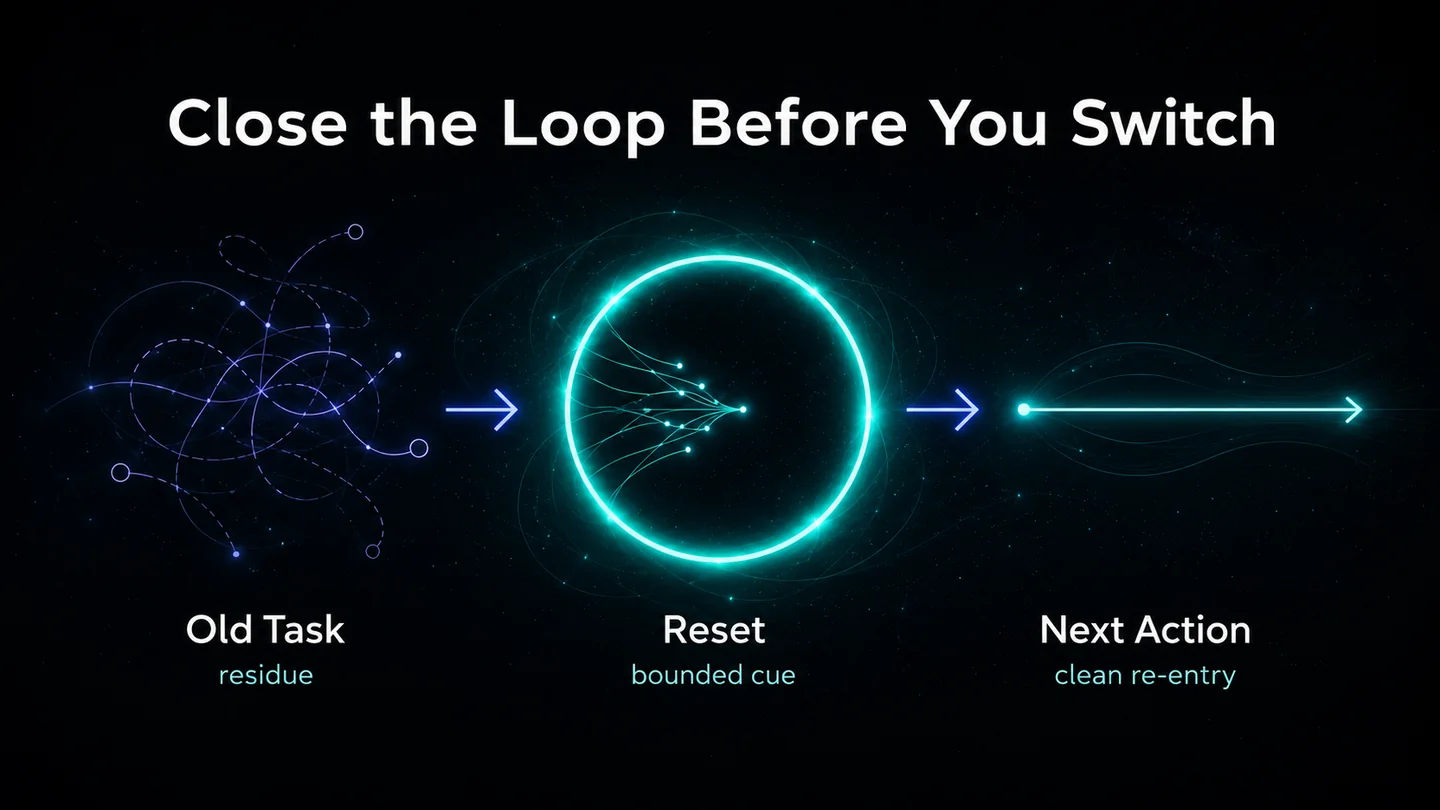
Most professionals leave their mental fitness to chance. They finish a taxing two-hour strategic meeting and immediately switch tabs to process email, under the illusion that switching tasks is a form of rest. This is a fundamental misunderstanding of how the brain manages state transitions. You are not recovering; you are simply shifting the friction to a different cognitive domain while dragging the residue of the previous task along with you.
High performers understand that true recovery requires an active pattern interrupt. By explicitly naming the transition and using a structured, bounded sensory task—such as bilateral pacing—you give your working memory permission to close the previous loop. This structured approach to downtime is what separates those who sustain peak performance from those who inevitably crash into the afternoon wall.
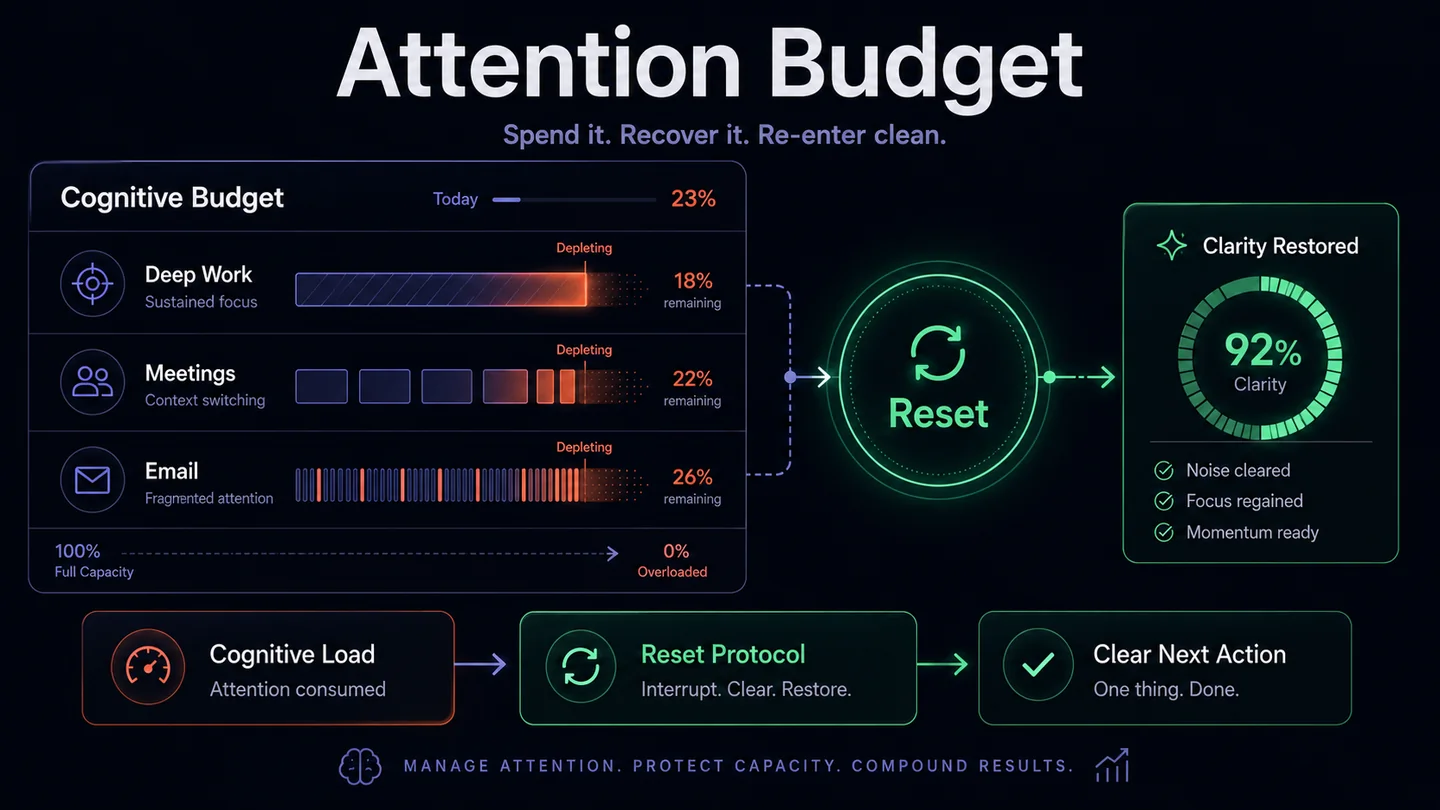
The Trap of Passive Relaxation
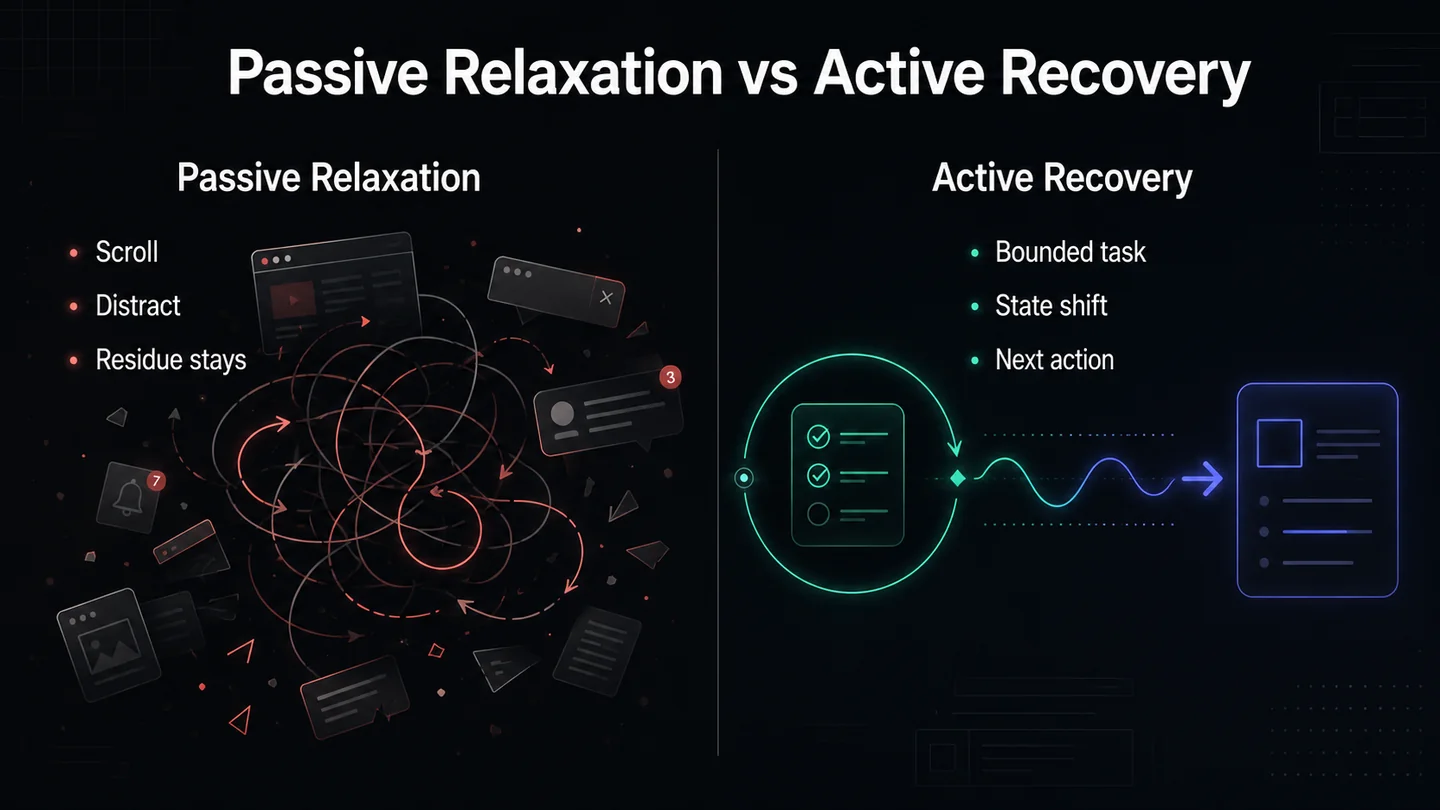
When we feel cognitively overloaded, the instinct is often to seek passive escape. We scroll through social media, watch a quick video, or scan the news headlines. But passive relaxation is a trap for the overstimulated mind. While your body might be still, your working memory is still thrashing, processing the unresolved loops from your workday underneath the distraction of the screen.
This is why you can spend an hour "relaxing" on the couch and still feel entirely unequipped to return to deep work. Your attention budget was not restored; it was merely distracted. Passive escape lacks the structural boundaries required to signal to your nervous system that a shift in state has actually occurred.
Active recovery, by contrast, requires a focused, bounded activity that occupies the channel rumination typically exploits. A five-minute bilateral pacing protocol does not ask your mind to be perfectly empty. Instead, it provides a highly salient, predictable tracking job. This occupies your cognitive bandwidth in a constructive way, starving the rumination loop of the oxygen it needs to persist.
Building Your Daily Recovery Stack
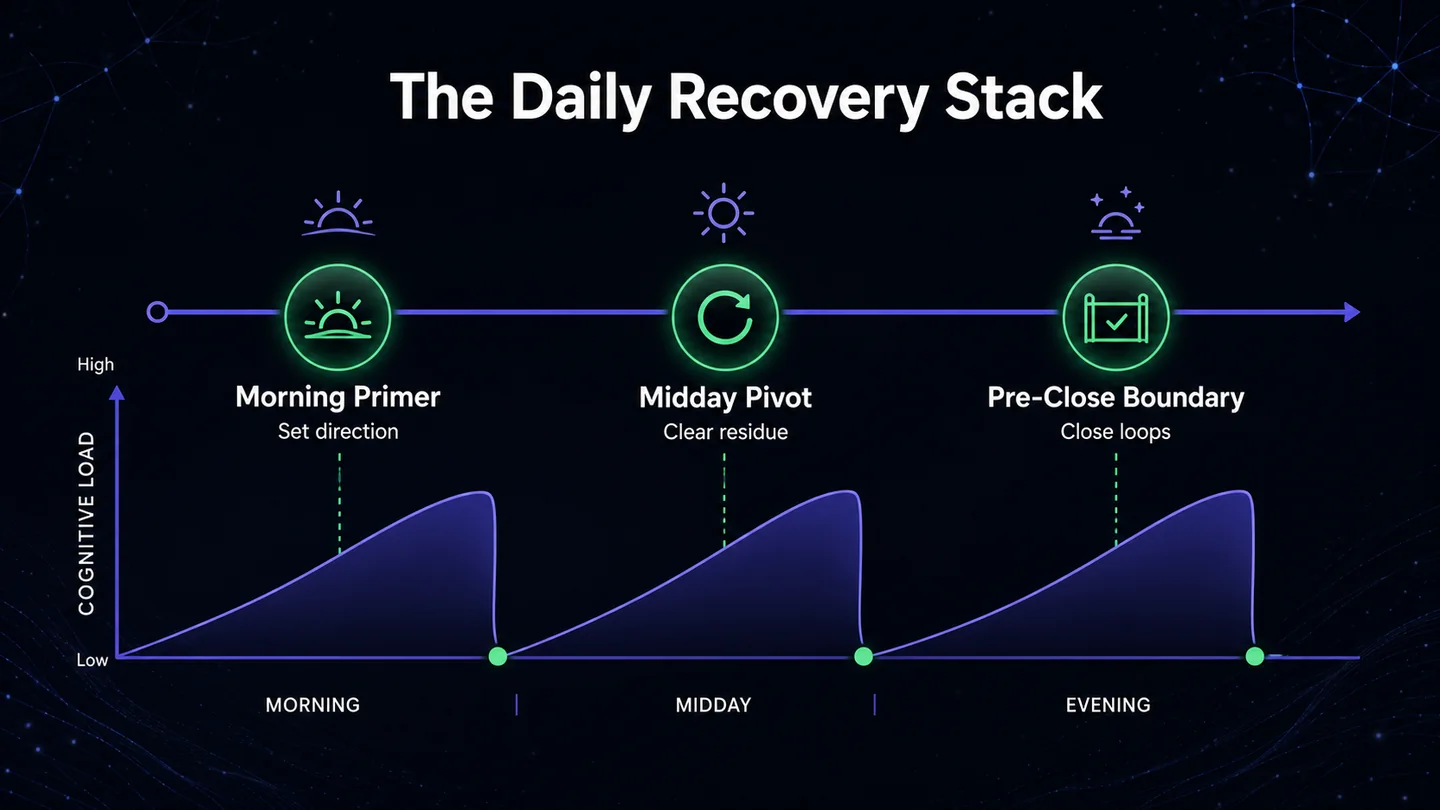
To implement this, you must treat your recovery protocols as non-negotiable appointments. The 'Recovery Stack' consists of three pivotal moments in your day: the Morning Primer, the Midday Pivot, and the Pre-Close Boundary.
The Morning Primer is a five-minute protocol executed before you open a single email. It involves setting a single, clear intention for the day’s first deep work block, followed by a focused pacing session to lock in your attention. The Midday Pivot occurs precisely when you feel the post-lunch slump or after the most demanding meeting of the day. This is a pure reset—a five-minute interval designed entirely to clear attention residue before the afternoon sprint.
Finally, the Pre-Close Boundary is perhaps the most critical. It is the hard stop at the end of your workday. You write down the exact starting point for tomorrow, run a Daily Reset session, and then physically step away from the machine. This stack requires less than fifteen minutes total, yet it fundamentally alters how your attention budget is spent and replenished.
Definition for quick answers
The High Performer’s Recovery Stack: Structure Your Downtime Like a Pro means this in MindSesh language: Passive relaxation rarely clears cognitive debt. To recover like an elite performer, your downtime needs as much intention as your deep work. It is a mental-fitness question about attention, load, and handoff, not just a feeling you should suppress.
Search intent: people looking for this usually want to know what is happening, what to do now, and which protocol fits. The short route is: name the signal (recovery, performance, advanced mental fitness), reduce the noise, and return with one observable action.
The quality bar is practical: after this article you should be able to say when to use it, which signal you are seeing, which session fits, and what action follows immediately after the session.
The useful mental model
Use the model input → load → protocol → handoff. Input is what the day throws at you. Load is what remains in working memory. The protocol is the short intervention that gives attention a shape. The handoff is the sentence or action that returns you to execution.
Without the handoff, even a good reset becomes a detached experience. With the handoff, Advanced Mental Fitness becomes trainable: same cue, same session, same way to enter the next block.
What this means in practice
Use Daily Reset when this topic shows up in your workday. Choose breathing when the body still feels activated, bilateral pacing when replay or residue is the main noise, and NSDR when depletion is louder than confusion.
Write one line before the session about what is open. Write one line after the session about what starts now. Those two lines turn "I tried something" into a real work handoff.
Evidence-aware note
Evidence-aware note: this article stays evidence-informed and practical. We do not claim a universal outcome; we describe a repeatable cue-protocol-handoff for ordinary work load.
The MindSesh position stays narrow: short, browser-native protocols for ordinary work load and performance hygiene. No account wall, no download, no vague wellness wallpaper. Start fast, finish the loop, return.
Protocol Steps
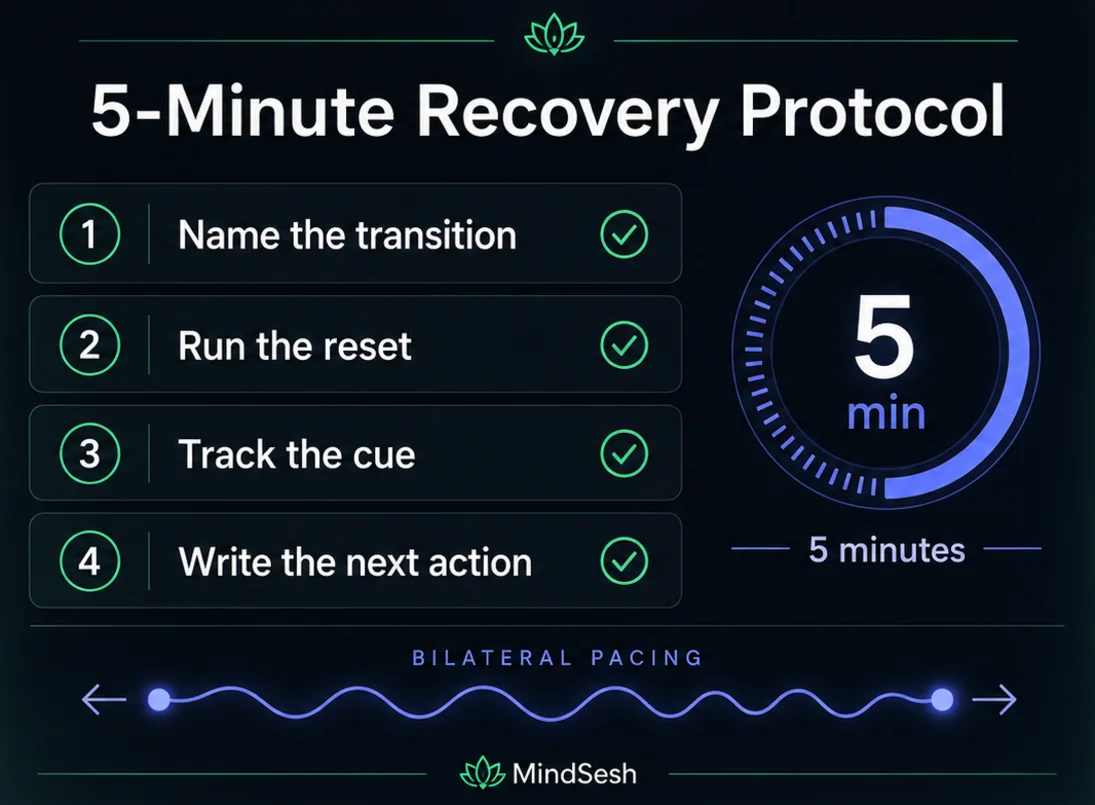
- 1. Audit your current breaks — For one day, notice what you actually do between tasks. Are you passively scrolling or actively recovering? Label the habit without judgment.
- 2. Establish the Midday Pivot — Pick the hour where your energy reliably dips. Block five minutes on your calendar for a [Reset session](/en/session/reset).
- 3. Follow the bilateral pacing — During the session, treat tracking the visual and audio stimulus as your only job. Do not negotiate with your inbox.
- 4. Write the exit condition — Before the session ends, write down the one literal task you will do next. Execute it immediately when the tone finishes.
- 5. Name the signal — Write one line naming the problem: residue, activation, depletion, task ambiguity, or open loop.
- 6. Choose one protocol — Open [Daily Reset](/en/session/reset) and keep it to one complete session. Do not stack protocols before you know what the first one changed.
- 7. Exit with a handoff — Write one observable next action. If another person could not see the action happen, it is still too vague.
Frequently Asked Questions
Try the session
Open session →